Methodology
The GRANDE methodology combines computational modelling, experimental validation, and industrial-scale testing to develop a scientific approach for gas atomization nozzle design.
By integrating modelling, experimentation, and industrial validation, GRANDE will establish a predictive and data-driven methodology for producing high-quality steel powders with lower waste, reduced energy consumption, and improved process efficiency.
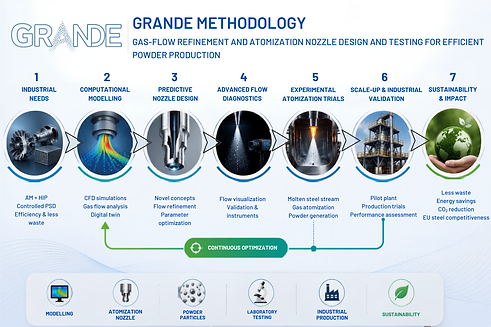
Computational design and simulation
Advanced numerical models are used to analyse gas flow behaviour, molten metal breakup, and particle formation, allowing the optimization of nozzle geometries before manufacturing.
Flow diagnostics and experimental testing
State-of-the-art measurement techniques are applied to validate simulation results and better understand the interaction between gas jets and molten metal streams.
Nozzle optimization
Different nozzle concepts are designed, manufactured, and tested to identify configurations that improve atomization efficiency, powder quality, and process stability
Process parameter assessment
Key operating parameters, such as gas pressure, flow rates, and nozzle geometry, are systematically evaluated to establish their influence on particle size distribution and production yield
Pilot-scale validation
The optimized nozzle designs and process configurations are tested under industrially relevant conditions to demonstrate their performance and scalability
Sustainability and performance assessment
The methodology includes evaluating energy consumption, material efficiency, production costs, and environmental impacts to ensure that the developed solutions contribute to a more sustainable steel powder production process




Workpackages
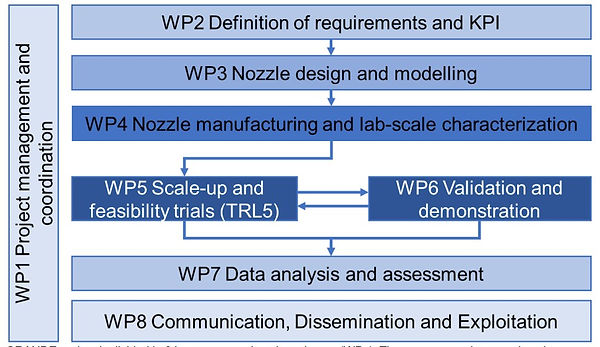
GRANDE project is divided in 8 interconnected work packages (WPs). The structure and connections between the different WPs has been defined in order to have a clear project plan and highlight the subsequent and parallel activities that will be carried out to achieve the ambitious GRANDE objective.
All activities related to project management, coordination and interaction with the European Commission will be carried out in WP1. In WP2 the requirements of the different scenario will be further defined together with the project activity plan and possible updated of KPIs.
WP3 will be dedicated to the development of CFD methodology for nozzle design, while WP4 and WP5 will be dedicated to the lab-scale and further scale up of the experimental validation with powder production for both AM and HIP and detailed characterization.
In WP6 validation of GRANDE approach is carried out, while WP7 includes all environmental, economic and technoeconomic assessment.
Finally, in WP8, dissemination, communication and IPR management will be carried out to maximize GRANDE visibility and its impact to the steel community.